



NOISE
**June of 2009 important update**
It is never too late for learning they say... Indeed, after a few members of the Perseus YG reacted to a post I published about a DX Engineering RPA-
Then, the key message (#4966) came from Bill W4ZV in response to the following (beginning of quoted text):
>>What *is* interesting is that the noise drops while the signals increases, like magic....A >>"normal" amplifier can not see any difference between wanted signals and un-
>I suspect the problem here is common mode noise being fed to the Perseus but being >rejected at the RPA-
Yes, common mode noise rejected by the RPA-
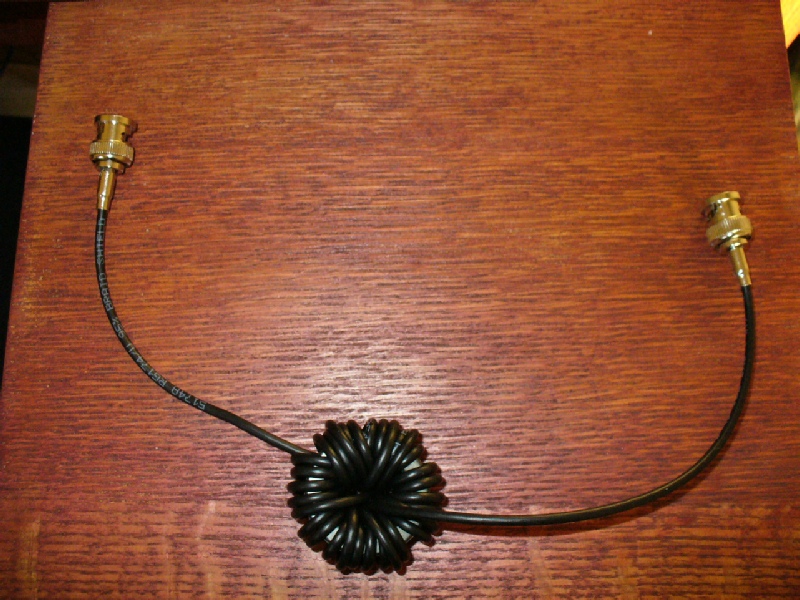
This is the choke
I used for
preliminary testing. I made it accordingly to Jürgen’s design by using a FT140-
While I was in quest of the optimal in-
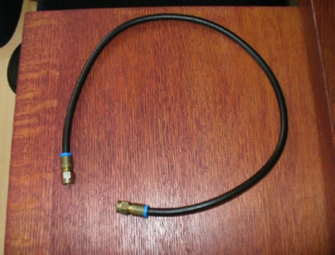
The next morning, I was horrified to find that even with the choke in place, the bad behaviour went back again in force so in a desperate move, I began moving the cables around the choke and I saw that the noise was flipping back and forth. So, this definitely had to be something around there. First, I thought of a faulty PL259 socket on the MFJ phaser chassis but even after it was replaced, the problem was still there. Finally, only a 30cm piece of cable that connects between the RPA-
And indeed, THAT was the problem. After having replaced the cable, the S/N ratio went back to a normal state.
An apparently harmless cable causing all that trouble! There must have been a fault in my coax preparation or an hidden imperfection when the cable was manufactured. One thing for sure is that I couldn't find anything unusual after doing a visual inspection around both connector areas.
Then with this problem fixed, the time came to begin “playing” with the chokes. As the noise floor was still a little high, there was still some room left for improvements. So, I decided to start my testing from feedpoint and later compare when connected in-
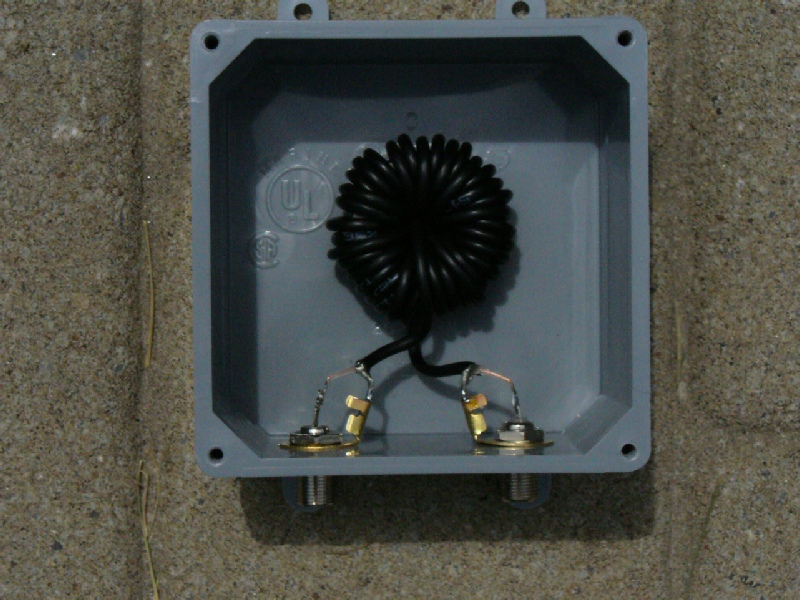
The choke itself mounted in a waterproof ABS plastic cabinet It literally connects through the feedline next to feedpoint. One leg of the matching transformer coax side has to be grounded for the choke to be efficient. Connectors are simple F female chassis mount. Hot glue has been used to tie the choke to the box.
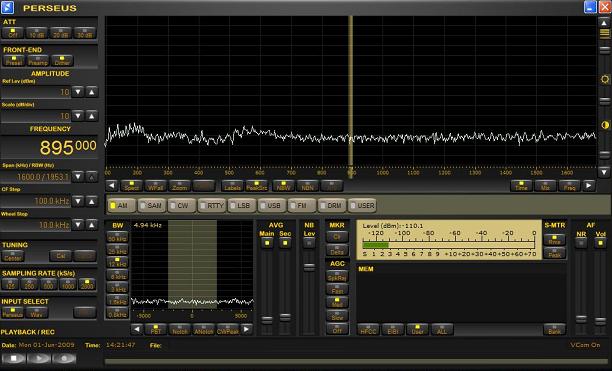
This without the choke inserted, noise floor @ 895 KHz was at -
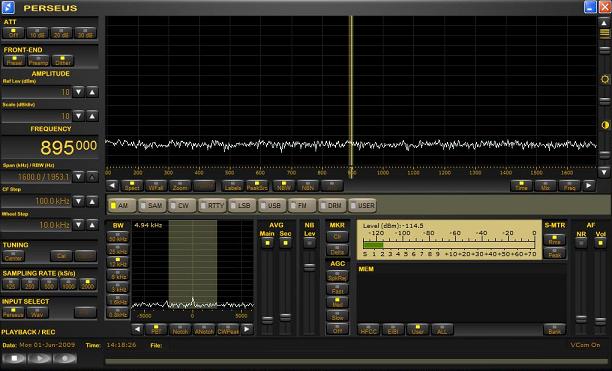
Here with the feedpoint choke inserted showing how the noise peaks were cut besides bringing the noise floor down to -
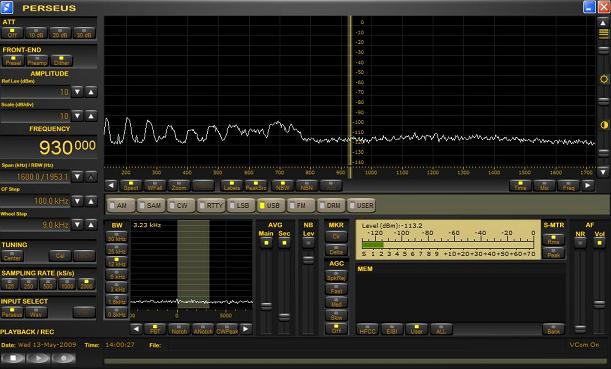
Here’s a screenshot with the faulty short cable connected. Both in-
So, -
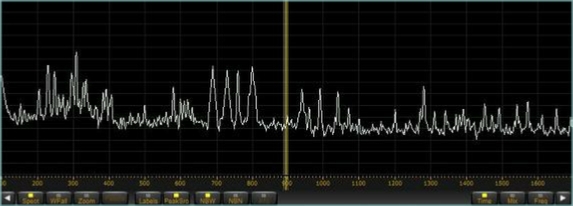
Now, what I have left in order to get the noise even lower is moving the feedpoint farther which is out of question. Don't expect me to make another trench into the forest and get the feedline buried that far. However, I still have that MFJ-
Initially, this phaser was used to null out adjacent or very close MW stations helping out revealing weaker TA. But frankly, I rarely thought in using it to simply cancel the noise. My only concern is during a Perseus wideband recording. I doubt it could deliver flat and stable results all over both LW and MW bands. Some stations could be altered and other noise sources could remain present. Anyhow, this should probably be the best to be done for now.
I really want to thanks Jürgen Bartels for his great availability in this quest and also Leif Asbrink SM5BSZ for taking the time to analyze some of my wav files.
I've been triggered after numerous comments on the Perseus YG about the "miraculous" effect of the RPA-

***NOTE FROM 2011***
At the time the chokes were inserted, I went using a single large common ground connection for both Beverages’ matching transformers, the feedpoint’s remote control gear and chokes. Since I’ve been plagued with some buzz noise especially in the LF-
Click on the image to play in-
Furthermore, it also made a noticeable change in the Beverages directivity which is always good news. Encouraged by the results, I decided to put two more chokes, in-
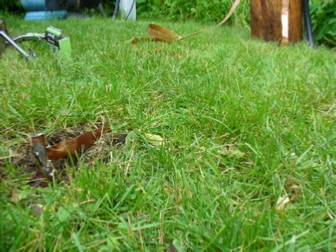
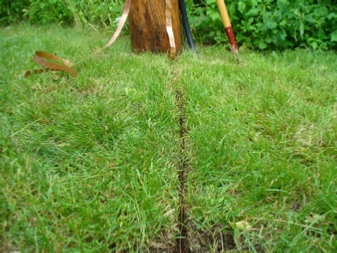
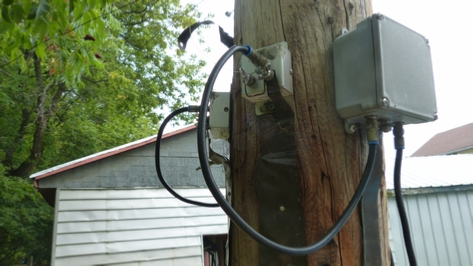

A view on one of the two choke enclosures next to feedpoint. Copper foil is my prime choice for ground connection as it provides a low impedance path to earth which is not bad against lightning and it also help to keep the noise away. On the two above pictures, you can see the base of the post that is used to hang our clothesline and this is also where all the wire antennas converge. The ground system consist in a total of five, 5/8 inch copper plated ground rods, each with a five foot length.
Three of those stands right at the base of the post This is where the feedpoints’ baluns and the remote antenna switcher (not visible here) connects. What is shown on the upper pictures are the other two remaining rods, entirely buried and away from the post, on which I welded the copper ribbon coming down from the choke box and through a trench into the soil.
Feedpoint
Choke Box
Buried ground rod with the copper ribbon welded to it
Trench
Page revised and updated in Nov 2017
| Receiving Station Setup |
| Receivers |
| Antennas |
| Line / Antenna switchers |
| Lightning protection |
| Others |
| Conventional receivers |
| Microtelecom Perseus |
| SDRPlay |
| Beverages |
| K9AY |
| PA0RDT Mini-Whip |
| Miscellaneous |
| Asian audio files |
| African audio files |
| European audio files |
| Middle-East audio files |
| Latin American-Caribbean audio files |
| 2015 St-Patrick' solar storm audio files |
| DX Curiosities |
| August 2007 bandscan |
| August 2014 bandscan |
| FMDX equipments |
| FM logs 2017-2018 |
| FM logs 2020 |
| FM logs 2021 |
| FM logs 2022 |
| FM logs 2023 |
| FM logs 2025 |